
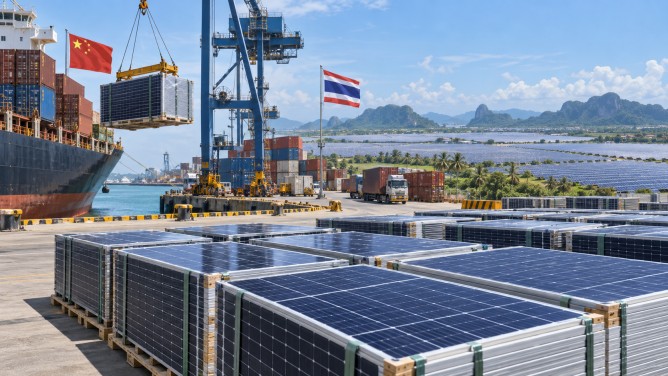
Thailand’s solar panel imports experienced a substantial increase, jumping 88.7% year-on-year to reach $426.7 million during the first seven months of 2026, according to data from Thailand’s Ministry of Commerce and Customs Department. This surge is predominantly attributed to imports from China, which accounted for a staggering 99.3% of the total, reflecting a 107.1% rise to $423.9 million compared to the same period last year.
As Thailand moves forward with a comprehensive household solar installation initiative, this increase in imports aligns with the country’s strategic energy goals. The program aims to subsidize solar installations with approximately THB50,000 per household, initially targeting one million homes with a potential expansion to 1.5 million. The initiative is part of Thailand’s broader effort to reduce electricity costs and promote clean energy usage domestically.
In addition to boosting imports, the Thai government is actively exploring measures to enhance local solar manufacturing capabilities. Collaborations with the Ministry of Labour are underway to develop a skilled workforce proficient in the assembly, installation, and maintenance of solar panels. Furthermore, discussions with the Board of Investment are focused on lowering duties on production inputs that are not available within the country, a move intended to bolster domestic production.
While China remains the primary supplier, Singapore and Hong Kong also contribute to Thailand’s solar panel imports, albeit at a significantly smaller scale, each accounting for roughly 0.3% of the total value. This diversification, though limited, indicates Thailand’s interest in exploring multiple supply channels to support its energy transition.
Thailand’s emphasis on expanding its solar energy infrastructure not only aims to deliver immediate cost savings for consumers but also supports the establishment of a resilient, local clean-energy supply chain. By fostering both import and domestic production capabilities, the country is positioning itself to meet rising energy demands sustainably.